Review of Trades and Trading Tips for the Japanese Yen
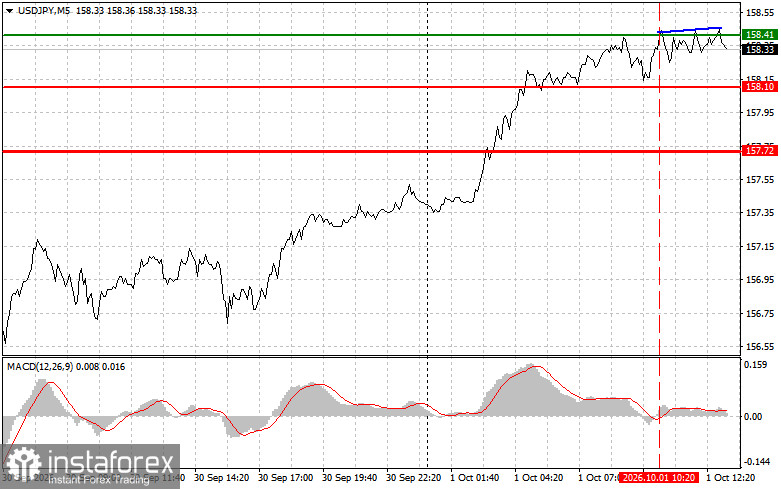
The test of 158.41 occurred when the MACD indicator had just started moving upward from the zero line, confirming the validity of the entry point for a long position in the dollar. However, as you can see on the chart, the pair did not make a significant upward move.
The yen ignored Japanese Prime Minister Sanae Takaichi's plans. The currency did not react to today's announcement, and there is a reason for this. The government announced that by the end of the year, it would determine the details of the first five years of its 370 trillion yen investment program, approximately $2.3 trillion, which is planned through 2040. In essence, on Thursday, the Council for the Strategy of Economic Growth received neither funding nor specific projects, but rather a promise that the government would later announce the sectors, amounts, and sources of financing. Markets are driven by figures, not promises, and the figures are not yet available.
The essence of the plan is straightforward. Japan wants to attract 370 trillion yen in public and private funds to 17 key industries, including artificial intelligence, semiconductors, defense, and others. The projects considered most important for national security will be financed through a special account and partly through government bonds, which would add to public debt. Why did the yen remain unaffected? Because the main question of who will contribute more—the government or businesses—remains unanswered. In my view, the yen will remain largely unaffected by the program through the end of the year, until the government provides a breakdown of public and private funding.
Today's US economic data releases in the second half of the day appear to be of secondary importance. The only developments of interest are comments from Jeffrey Schmid and Susan Collins. The key question currently concerning the market is where US interest rates are headed next. The latest US inflation and employment data do not indicate an urgent need for higher rates, which already limits the dollar's upward potential to some extent. However, for the yen, which is already under pressure following today's disappointing Tankan data, any more hawkish comments from Schmid or Collins could mean further gains in USD/JPY and, consequently, an increased risk of verbal intervention by Japanese authorities.
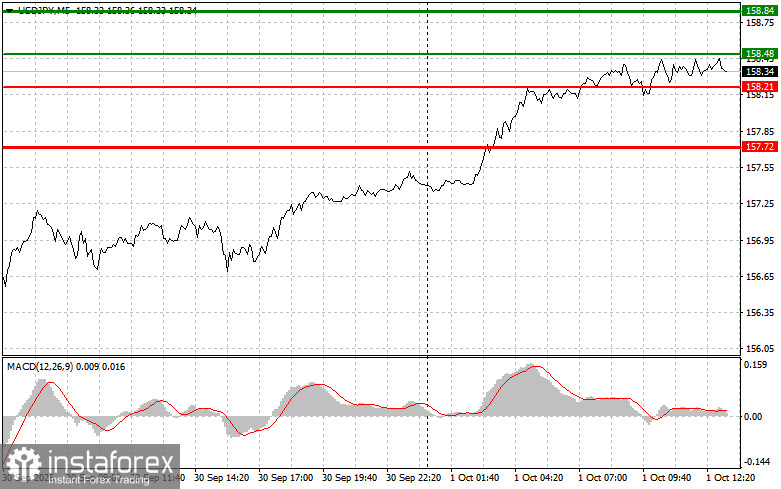
As for the intraday strategy, I will focus more on the implementation of Scenarios 1 and 2.
Buy Signal
Scenario 1: I plan to buy USD/JPY today when the entry point is reached around 158.48 (the thin green line on the chart), targeting a rise toward 158.84 (the thicker green line on the chart). Around 158.84, I will close the long position and open a short position in the opposite direction, targeting a move of 30–35 points in the opposite direction from the level. The pair may rise today, but the upward potential is relatively limited. Important! Before buying, make sure that the MACD indicator is above the zero line and has only just started rising from it.
Scenario 2: I also plan to buy USD/JPY today if the price tests 158.21 twice consecutively while the MACD indicator is in the oversold zone. This would limit the pair's downward potential and lead to an upward reversal. A rise toward the opposite levels of 158.48 and 158.84 can be expected.
Sell Signal
Scenario 1: I plan to sell USD/JPY today after the price breaks below 158.21 (the thin red line on the chart), which should lead to a rapid decline in the pair. The key target for sellers will be 157.72, where I will close the short position and immediately open a long position in the opposite direction, targeting a move of 20–25 points in the opposite direction from the level. Downward pressure on the pair may return if the central bank intervenes. Important! Before selling, make sure that the MACD indicator is below the zero line and has only just started declining from it.
Scenario 2: I also plan to sell USD/JPY today if the price tests 158.48 twice consecutively while the MACD indicator is in the overbought zone. This would limit the pair's upward potential and lead to a downward reversal. A decline toward the opposite levels of 158.21 and 157.72 can be expected.
What the Chart Shows:
- Thin green line – the entry price at which the trading instrument can be bought;
- Thick green line – the estimated price at which Take Profit orders can be placed or profits can be taken manually, as a further rise above this level is considered unlikely;
- Thin red line – the entry price at which the trading instrument can be sold;
- Thick red line – the estimated price at which Take Profit orders can be placed or profits can be taken manually, as a further decline below this level is considered unlikely;
- MACD indicator. When entering the market, it is important to take overbought and oversold zones into account.
Important. Beginner Forex traders should exercise great caution when making entry decisions. Before the release of important fundamental reports, it is generally best to remain out of the market to avoid exposure to sharp price fluctuations. If you decide to trade during news releases, always use stop orders to minimize losses. Without stop orders, you can lose your entire deposit very quickly, especially if you do not use proper money management and trade with large position sizes.
And remember that successful trading requires a clear trading plan, such as the one presented above. Making spontaneous trading decisions based on the current market situation is inherently a losing strategy for an intraday trader.